

Vadzo Imaging Launches Industry-First USB 3.2 Gen 2x2 UVC Camera Family Built on Infineon FX20 Platform
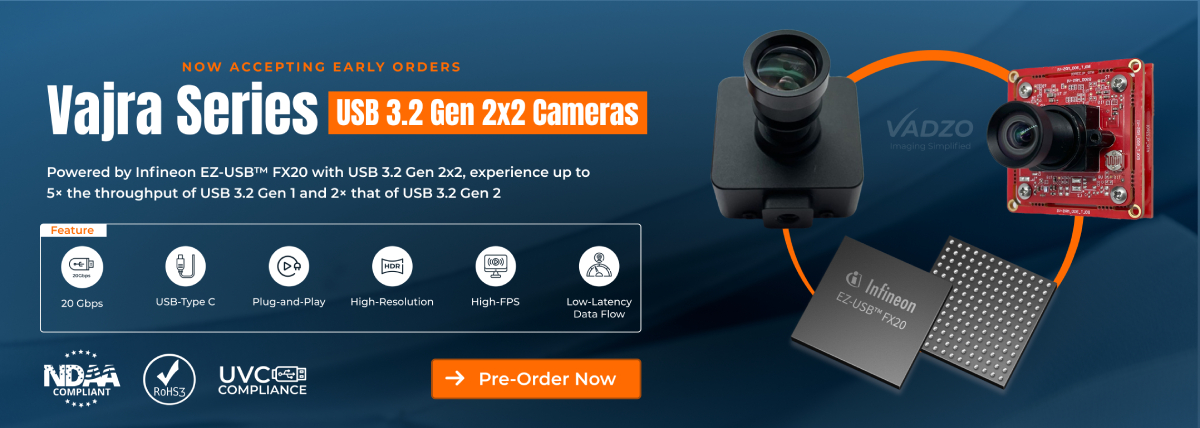
Vadzo's Vajra series
USB 3.2 Gen 2x2 UVC | Infineon EZ-USB™ FX20 Controller | Upto 20 Gbps SuperSpeed USB-C | Fixed-Focus & Autofocus Variants | Global & Rolling Shutter Options
SEOUL, SOUTH KOREA, May 28, 2026 /EINPresswire.com/ -- Vadzo Imaging, a global innovator in embedded vision, today launched the Vajra Series USB 3.2 Gen 2x2 UVC Cameras, introducing a new class of UVC cameras powered by 20 Gbps USB Type C interface. The leap in bandwidth allows designers to stream higher resolutions and frame rates, support multiple sensors over a single link, and reduce end-to-end latency-overcoming the bottlenecks of USB 3.2 Gen1 and Gen2 camera architectures.
Powered by the Infineon FX20 USB controller, the Vajra Series delivers sustained, 24/7 image transfer for mission-critical applications in industrial automation, robotics, medical imaging, and edge AI. The platform supports fixed-focus and autofocus lenses, global shutter, HDR, and low-light/NIR variants, with native USB Video Class (UVC) compliance for seamless deployment without custom drivers.
Highlights
Vadzo Imaging introduces the Vajra Series, a USB 3.2 Gen 2x2 UVC embedded camera family leveraging 20 Gbps interface bandwidth for high-resolution, high-frame-rate vision applications. The camera series delivers throughput in the range of 5 times the throughput provided by USB 3.2 Gen 1 cameras and 2 times the throughout provided by USB 3.2 Gen 2 cameras.
Based on the Infineon EZ-USB™ FX20 controller, enabling low-latency, deterministic UVC streaming over USB-C with sustained 24/7 operation.
Flexible imaging configurations including global shutter, HDR, autofocus and fixed-focus optics, and NIR/low-light-optimized variants
Standards-driven integration with USB Video Class (UVC) compliance and VISPA ARC SDK support for industrial automation, robotics, edge AI, and high-speed imaging systems
Vajra USB 3.2 Gen 2x2 UVC Camera Series Architecture
The Vajra Series is built on USB 3.2 Gen 2x2 SuperSpeed architecture, aggregating dual 10-Gbps lanes over a USB-C interface to enable up to 20 Gbps of interface bandwidth for UVC video transport. This leap in bandwidth allows cameras to stream higher resolutions and frame rates, support uncompressed and high-bit-depth formats, and aggregate multiple image streams on a single cable, capabilities beyond USB 3.2 Gen1 and Gen2 designs.
Powered by the Infineon EZ-USB™ FX20 controller, the platform aims to deliver deterministic, low-latency streaming across extended duty cycles. The architecture is engineered for continuous operation in robotics, industrial automation, medical imaging, and embedded edge AI systems where reliable, real-time image delivery is critical.
What the Vajra USB 3.2 Gen 2x2 Camera Series Delivers :
SuperSpeed USB 3.2 Gen 2x2 (20 Gbps Interface): Enables uncompressed and high-bit-depth imaging at higher frame rates, supporting single- and multi-stream UVC video on one USB-C link.
USB-C Single-Cable Deployment: Unified data and power interface simplifies system design, reducing cabling complexity in industrial and embedded installations.
Deterministic Low-Latency Streaming: Optimized UVC transport for real-time image delivery in motion control, robotics, and time-critical vision applications.
High-Resolution, High-FPS Capture: Supports detailed imaging without compromising frame rate, ideal for inspection, guidance, and AI inference workloads.
Native UVC Compatibility: Plug-and-play operation across Windows, Linux, and Android without custom drivers, with support for VISPA ARC SDK integration.
Imaging Portfolio
The Vajra Series allows a versatile range of imaging set ups for a series of embedded vision application needs:
Vajra-2020MRS - Onsemi AR2020 20MP NIR Monochrome USB 3.2 Gen 2x2 UVC Camera
Vajra-900MGS - Sony Pregius S IMX900 3MP NIR Global Shutter USB 3.2 Gen 2x2 UVC Camera
Vajra-1335CRA - Onsemi AR1335 13MP Color Autofocus USB 3.2 Gen 2x2 UVC Camera
Vajra-821CRS - Onsemi AR0821 4K HDR USB 3.2 Gen 2x2 UVC Camera
VISPA ARC SDK
Vadzo's VISPA ARC SDK, which is a software suite for camera control, video streaming, and sensor-level configuration, completely supports all the Vajra Series cameras. The SDK opens to the developers a lot of opportunities to:
Set up a dynamic ROI for application-driven field-of-view optimization
Manage ROI-based auto exposure for consistent imaging
Control trigger and flash synchronization for motion-critical scenes
Access sensor settings, binning, windowing, and frame timing
Handle firmware setup and management
VISPA ARC offers APIs in C, C++, C#, and Python, which allow to easily integrate them into embedded and edge vision applications with a very low level of complexity in the host.
Target Applications
The Vajra USB 3.2 Gen 2x2 UVC Camera Series is designed for embedded vision systems that require higher frame rates, richer image formats, and lower latency than conventional USB camera platforms. By leveraging USB 3.2 Gen 2x2 bandwidth, the series supports uncompressed and multi-stream imaging workflows for data-intensive machine vision and edge AI applications. The Vajra series ideally suitable for:
Industrial Automation & Inspection: High-frame-rate uncompressed imaging for PCB inspection, semiconductor wafer analysis, metrology, and precision quality control where compression artefacts or bandwidth-limited frame rates introduce measurement error or missed defect detection.
Robotics & Autonomous Systems: Real-time vision for pick-and-place cells, conveyor guidance, AMRs, AGVs, and collaborative robot platforms where deterministic latency and distortion-free capture under motion are required for reliable positioning and path planning.
Commercial & Enterprise Imaging: Document capture, kiosk vision, barcode and OCR systems, and on-device visual analytics where autofocus, high resolution, and stable USB-C integration into compact form factor devices are system requirements.
Intelligent Monitoring: High-quality capture for traffic systems, perimeter analytics, and edge-deployed situational awareness applications where bandwidth headroom supports higher-resolution streams without compression overhead.
Low-Light & NIR Imaging: Biometrics, vein detection, material sorting, and other illumination-challenged environments where NIR-optimized monochrome sensors provide contrast that visible-band color sensors cannot achieve under available illumination.
Motion & High-Speed Capture: Sports analytics, laboratory instrumentation, and scientific imaging requiring precise temporal resolution where global shutter architecture and high-bandwidth USB transport together eliminate both geometric distortion and interface bottlenecks.
HDR & Ultra-High-Resolution Workflows: Reflective surface inspection, wide dynamic range production scenes, and imaging workloads that demand maximum spatial detail and tonal range within a single uncompressed frame.
Frequently Asked Questions
What is USB 3.2 Gen 2x2 and how does it differ from USB 3.2 Gen 1 and Gen 2 for camera applications?
USB 3.2 Gen 2x2 aggregates two independent 10 Gbps lanes over a single USB-C connector, delivering up to 20 Gbps of interface bandwidth. USB 3.2 Gen 1 provides 5 Gbps and USB 3.2 Gen 2 provides 10 Gbps over a single lane. For camera applications, this bandwidth difference determines the maximum uncompressed resolution, frame rate, and bit depth you can sustain over the cable. At 5 Gbps, uncompressed 4K at high frame rates requires compression or resolution compromises. At 20 Gbps, cameras can stream uncompressed 4K and beyond at higher frame rates, support high-bit-depth formats, and even carry multiple sensor streams on a single cable — none of which are practical on Gen 1 or Gen 2 platforms.
Why does the Vajra Series use the Infineon EZ-USB FX20 controller rather than a conventional USB bridge?
The EZ-USB FX20 is one of the few USB controllers purpose-built for USB 3.2 Gen 2x2, natively supporting both 10 Gbps lanes simultaneously without lane bonding workarounds. Beyond raw bandwidth, the FX20 is engineered for deterministic, low-latency UVC transport — meaning frame delivery jitter is minimized across extended operating cycles. This matters in robotics and motion control where irregular frame delivery causes timing errors in downstream vision pipelines. Conventional USB bridges typically top out at Gen 2 and lack the sustained throughput characteristics required for 24/7 industrial duty cycles.
What does UVC compliance mean, and why does it matter for industrial and embedded system deployments?
USB Video Class (UVC) is a standardized USB device class that allows video devices to stream to a host without requiring custom drivers. A UVC-compliant camera works out of the box on Windows, Linux, and Android, eliminating driver development, kernel dependency management, and OS version compatibility concerns. For industrial OEMs and embedded system integrators, this dramatically reduces integration overhead — the camera can be evaluated immediately on any standard development platform and deployed across heterogeneous host environments without per-platform driver maintenance.
What sensor variants are available in the Vajra Series, and how should I choose between them?
The Vajra Series currently spans four distinct imaging configurations. The Vajra-2020MRS uses the Onsemi AR2020 20MP NIR monochrome sensor — suited for high spatial resolution inspection and NIR illumination environments. The Vajra-900MGS uses the Sony Pregius S IMX900 3.2MP global shutter monochrome sensor — the correct choice for motion-sensitive or high-speed capture applications where distortion-free imaging is required. The Vajra-1335CRA uses the Onsemi AR1335 13MP color sensor with autofocus — appropriate for document capture, barcode reading, and applications requiring variable working distance. The Vajra-821CRS uses the Onsemi AR0821 4K HDR color sensor — designed for scenes with mixed surface finishes or wide dynamic range lighting conditions. The right choice depends on whether your application is limited by resolution, motion, dynamic range, or depth of field variability.
What are the practical throughput improvements of USB 3.2 Gen 2x2 for common machine vision workloads?
At Gen 1 (5 Gbps), uncompressed 12MP at 30fps is near the bandwidth ceiling, and 20MP uncompressed streaming at any useful frame rate is not possible without compression. At Gen 2 (10 Gbps), 20MP at low frame rates becomes feasible but leaves little headroom for additional streams or higher bit depths. At Gen 2x2 (20 Gbps), the Vajra-2020MRS can stream 20MP uncompressed at rates impractical on prior generations, while the Vajra-821CRS can deliver 4K HDR data at frame rates sufficient for high-speed inspection without compression artefacts. The practical gain is not just peak throughput — it is the elimination of compression dependencies that introduce latency, block artefacts, and pipeline complexity in downstream AI inference and measurement workflows.
Availability
The Vajra Series is available for evaluation and early orders. For technical documentation, configuration options, and sample purchases, visit www.vadzoimaging.com or contact Vadzo Imaging sales.
About Vadzo Imaging
Vadzo Imaging is a provider of embedded vision cameras and imaging platforms across USB, MIPI, GigE, Wi-Fi, and SerDes interfaces. The company develops OEM embedded cameras for industrial automation, robotics, healthcare, smart mobility, and edge AI applications, with a focus on high-performance imaging, long-term reliability, and flexible system integration. Vadzo supports customers with hardware customization, firmware, and SDK tools to accelerate vision product development.
Alwin Vincent
Vadzo Imaging
+1 817-678-2139
alwin@vadzoimaging.com
Visit us on social media:
LinkedIn
YouTube
X
Legal Disclaimer:
EIN Presswire provides this news content "as is" without warranty of any kind. We do not accept any responsibility or liability for the accuracy, content, images, videos, licenses, completeness, legality, or reliability of the information contained in this article. If you have any complaints or copyright issues related to this article, kindly contact the author above.
