

The National Space Society Recognizes China for its Successful Rendezvous with Asteroid Kamo’oalewa
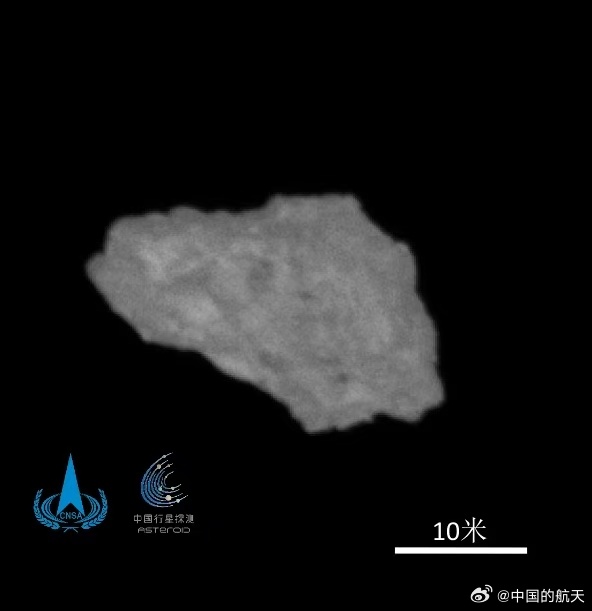
Asteroid Kamoʻoalewa. Credit: CNSA
Tianwen-2 Spacecraft is Scheduled to Return Samples of the “Mini-Moon” to Earth in 2027
Besides the intense scientific interest, this is another step toward utilizing the rich resources of accessible asteroids to boost the human settlement of the Earth-Moon system and beyond.”
MERRIT ISLAND, CA, UNITED STATES, July 6, 2026 /EINPresswire.com/ -- The National Space Society (NSS) commends the China National Space Administration (CNSA) on the announcement of the successful arrival of its Tianwen-2 spacecraft at asteroid 469219 Kamoʻoalewa. The spacecraft launched on May 28, 2025, and is reportedly positioned to begin the most critical phase of its deep-space mission—preparing to sample the asteroid. If China is successful in this, and in returning the sample to Earth, it would be the third nation to do so after Japan (Hayabusa 1 in 2010 and Hayabusa 2 in 2020) and the United States (OSIRIS-Rex in 2023).— Dale Skran, COO & SVP, National Space Society
Kamoʻoalewa measures between 130 to 330 feet (40 to 100 meters) across and its name means “oscillating celestial object” in Hawaiian. Depending on the precise measurements obtained by Tianwen-2, it could officially become the smallest asteroid ever visited by a spacecraft.
Though often referred to as a "mini-moon," Kamoʻoalewa is not a true satellite of Earth. Instead, it is a quasi-satellite—one of only seven known objects that orbit the Sun while remaining locked in perfect synchronization with Earth's orbit. Some astronomers have hypothesized that Kamoʻoalewa may actually be an ancient fragment of Earth's own Moon, blasted into space during a massive impact long ago.
“We welcome China into the family of nations to rendezvous with, study, and sample asteroids,” said Dale Skran, COO and SVP of the NSS. “Besides the intense scientific interest, this is another step toward utilizing the rich resources of accessible asteroids to boost the human settlement of the Earth-Moon system and beyond. This type of exploration also helps us to plan the protection of Earth from larger rogue asteroid impacts.”
Over the next nine months, Tianwen-2 will map the asteroid in high resolution to identify a secure landing site. It will then employ a touch-and-go sampling system and an advanced anchor-and-attach mechanism featuring surface drills to collect about 3.5 ounces (100 grams) of surface material. If successful, the spacecraft will depart the asteroid in April 2027, with its return capsule projected to land on Earth the following November. Meanwhile, Tianwen-2 will execute a gravity-assist maneuver to slingshot across the solar system toward its secondary target, comet 311P/PANSTARRS, where it is expected to arrive in January 2035.
ABOUT THE NSS
The National Space Society is the preeminent non-partisan citizens’ voice on space exploration, development, and settlement, reaching millions through its membership, numerous outreach channels, and media activities. The organization was founded in 1987 via a merger of the National Space Institute and the L5 Society. To learn more about the NSS and its mission to establish humanity as a spacefaring species, visit us on the web at nss.org.
Rod Pyle
National Space Society
email us here
Visit us on social media:
LinkedIn
Instagram
Facebook
YouTube
X
Legal Disclaimer:
EIN Presswire provides this news content "as is" without warranty of any kind. We do not accept any responsibility or liability for the accuracy, content, images, videos, licenses, completeness, legality, or reliability of the information contained in this article. If you have any complaints or copyright issues related to this article, kindly contact the author above.
