

What Defines Weilong Technology as a Reliable Custom Solenoid Pump Factory in China for Industrial Applications?
Off-the-shelf pumps serve general purposes, but increasingly, system integrators find that the fluid, the duty cycle, or the control interface calls for a pump engineered from scratch for a specific task. This is where application-driven manufacturers distinguish themselves from catalog resellers — and where Weilong Intelligent Technology (Dongguan) Co., Ltd. has built its position over nearly two decades of focused electromagnetic actuator development.
Q1: What Does "Custom" Actually Mean — Beyond Relabeling a Standard Pump?
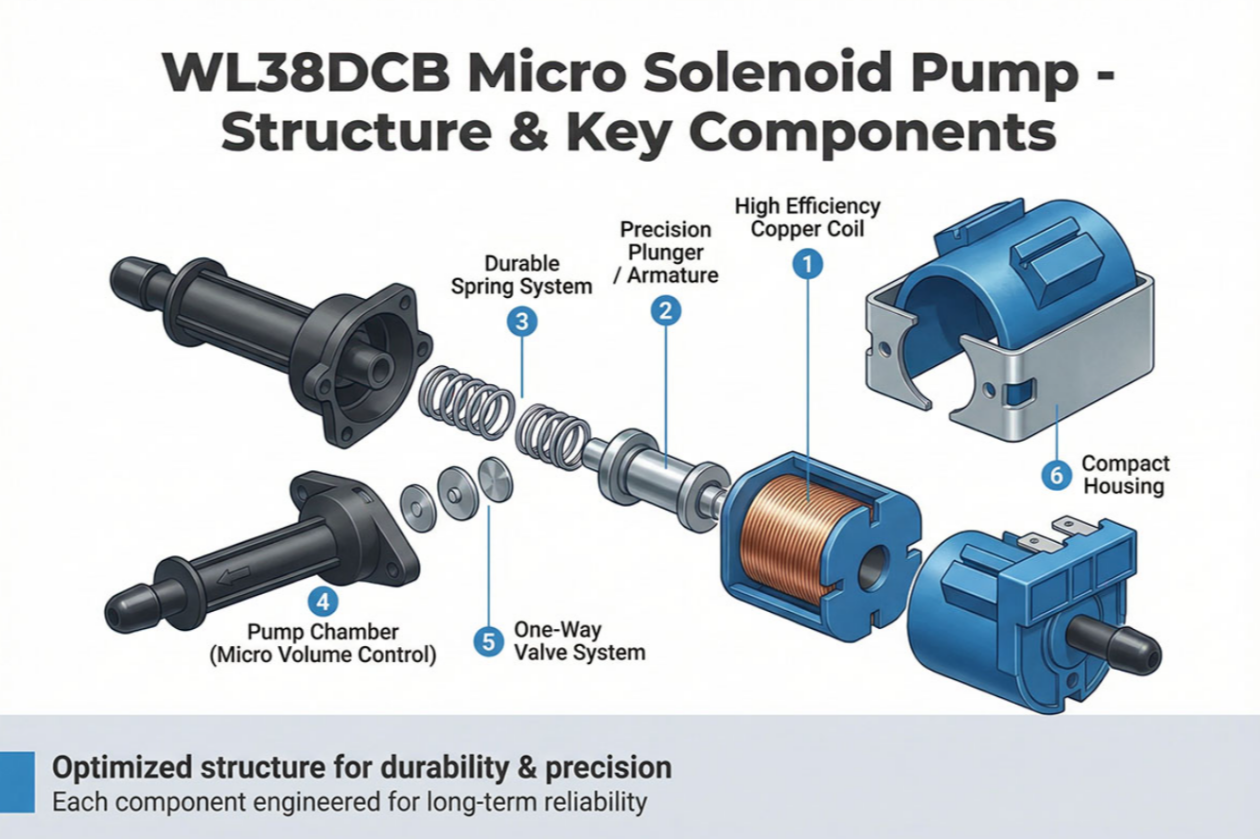
Here is a blunt truth: plenty of suppliers slap a "custom" label on a stock pump and call it done. Real customization looks nothing like that. A proper custom solenoid pump begins at the application end — what fluid runs through it, at what pressure, how often, and how the host system talks to it — and then the engineering works backward into materials, geometry, and electronics. Weilong's pump lineup shows what that looks like in practice. Coil voltages come in 12V and 24V DC variants, matching standard industrial and battery-powered setups. Diaphragm options include PTFE for handling aggressive acids in lab analyzers and Viton for hydrocarbon-laced fluids in fuel dosing rigs. Pump bodies can be machined from 316L stainless steel when corrosion resistance is non-negotiable, or molded in polypropylene where weight and cost matter more.
On the controls side, PWM-compatible drive circuits let the pump modulate flow precisely without bolting on an external controller. Take a medical dosing application: the stroke volume, valve seat geometry, and port sizing all get shaped by the reagent's viscosity and the accuracy target — not cherry-picked from a catalog page. That backward-from-the-application thinking is exactly what separates a genuine custom solenoid pump factory from a trading house with a short product list.
Q2: How Are Precision and Lifespan Maintained Under Real Industrial Conditions?
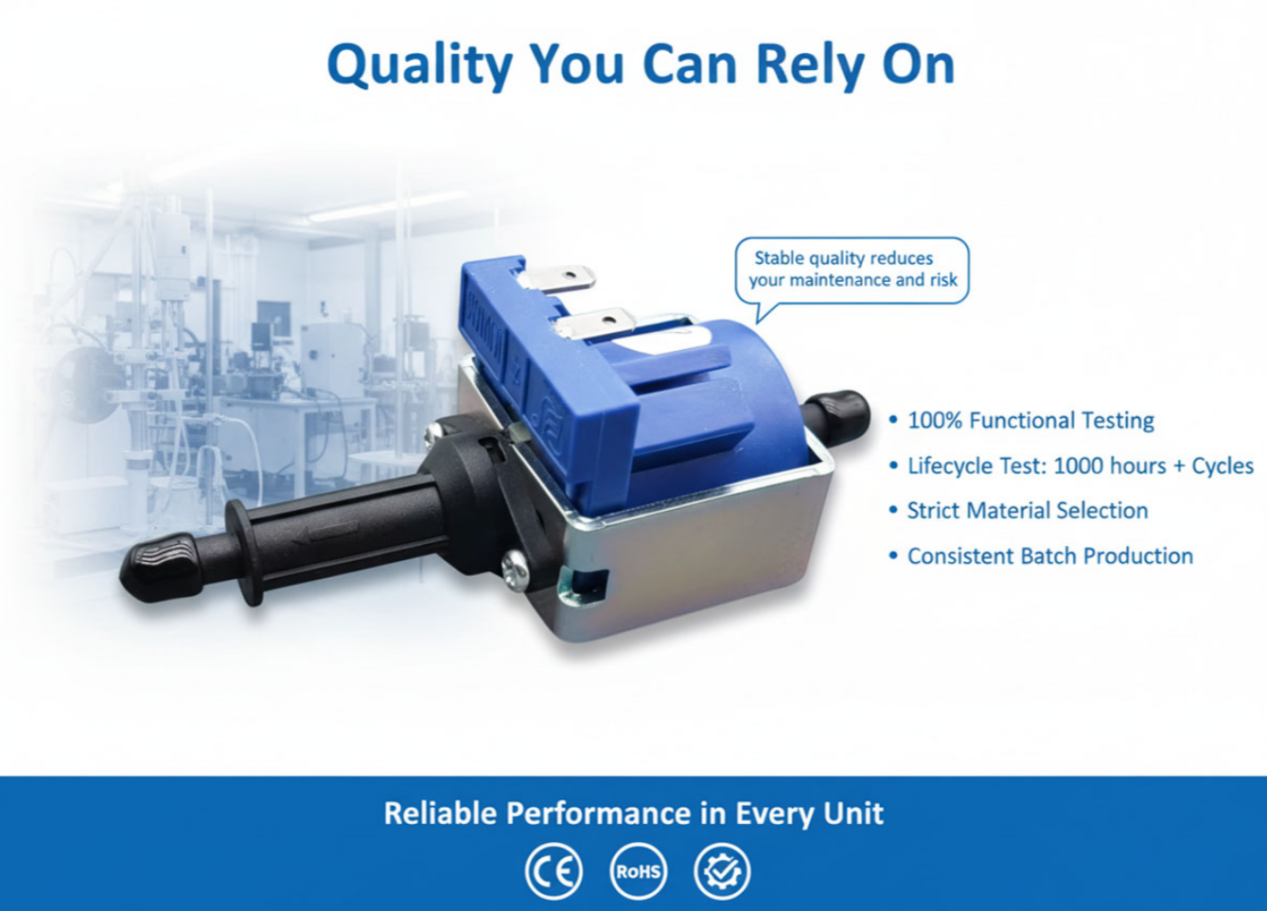
Datasheet specs are easy to print. Holding those specs at 60 degrees Celsius, after five million strokes, with fluctuating inlet pressure — that is the hard part. Weilong rates its solenoid pump products at plus or minus one percent metering accuracy, flow rates between 0.1 and 3 liters per minute in steady state, and cycle lives from one million up to ten million strokes, depending on the build. Numbers like these need proof, not just promises. Weilong Intelligent Technology (Dongguan) Co., Ltd. runs a dedicated in-house lab for both R&D validation and production quality checks. The lab handles pull and push force curves, response time measurements, coil temperature rise logging, accelerated life cycling, and piece-to-piece consistency audits.
Each pump gets full inspection, and all test records stay in the system — so a customer ordering 2,000 units can pull the force profile and leak-down data for that exact lot six months later. In regulated industries like medical devices or food-grade fluid handling, this kind of traceability is not optional. A solenoid pump factory that ships without traceable batch records is basically asking buyers to absorb risk on their behalf. Most serious procurement teams have stopped accepting that deal.
Q3: From Prototype to Volume Production — How Does the Transition Stay Smooth?
Ask any OEM integrator about their worst sourcing experience, and odds are good the story involves a prototype that worked perfectly and a production batch that did not. The "sample-to-batch gap" is real, and it kills projects. Weilong tackles it through vertical integration. The Dongguan facility packs in CNC machining centers, injection molding presses, coil winding equipment, and automated assembly stations — all under one roof. That setup keeps the feedback loop between engineering and the shop floor short and fast. Need a working prototype? Typical turnaround sits around two weeks. Once the design freezes, production shifts into CPK-driven process monitoring, tracking critical dimensions and magnetic force output on every run. Why does this matter so much for pumps specifically? Because solenoid pump performance hangs on tiny details. The air gap between plunger and stator, the seating force on the diaphragm, the tension in every coil winding — each one nudges metering accuracy and service life. Farm out even one of those steps to a subcontractor, and variation sneaks in quietly. It usually stays hidden until something fails in the field.
Engineering Support That Cuts Integration Risk
Weilong also publishes fluid compatibility lists for each pump configuration, covering common industrial chemicals, cleaning solvents, and biological media. More unusually, the engineering team keeps a running failure mode library — documenting things like coil overheating under continuous duty, valve seat clogging from particle-heavy fluids, and diaphragm fatigue caused by excessive back-pressure. Making that information available before a customer commits to a design saves weeks of validation testing and dramatically lowers the odds of an expensive field recall.
Q4: Why Do Overseas Integrators Come Back?
Transparency is the short answer. European and North American system integrators spend a lot of time and money qualifying new suppliers. A custom solenoid pump source that hands over failure data and honest design limits — not just glossy best-case charts — shortens that qualification clock considerably. But what actually drives repeat orders goes beyond openness. It comes down to predictability. A German medical device company reordering 3,000 dosing pumps expects the same force curve, the same flow tolerance, and the same box-level packaging quality it got last time. Weilong's quality system, built on traceable inspection records and statistical process controls, delivers exactly that kind of lot-to-lot sameness.
The company runs DFM reviews at the quotation stage too. If a requested part geometry is going to cause mold headaches at scale, or if a chosen elastomer will soften at the customer's stated operating temperature, those flags go up early — before anyone cuts steel for a tool. That kind of heads-up engineering communication reflects a culture driven by problem-solving rather than order-taking. Experienced buyers spot the difference fast.
Reliability Is Not a Slogan — It Is an Intersection
So, back to the original question: what makes Weilong a reliable custom solenoid pump factory in China? The answer is not one thing. Reliability in this space lives at the overlap of three capabilities — magnetic circuit know-how, a genuine understanding of the chemistry happening inside the pump head, and the production discipline to keep every lot tight. Weilong Intelligent Technology (Dongguan) Co., Ltd. brings nearly two decades of concentrated electromagnetic actuator experience, a vertically integrated plant that controls everything from winding copper wire to running final acceptance tests, and an engineering group that treats each custom solenoid pump project as a system problem, not a parts order.
For industrial buyers sizing up a solenoid pump factory partner in China, the evaluation goes well past price per unit. Traceability, application-matched design ability, fast prototyping, and batch-to-batch consistency — those are the factors that decide whether a supplier relationship lasts one purchase order or a full decade.
Industrial buyers looking for a custom solenoid pump partner built around application-specific engineering, traceable quality data, and consistent batch production are welcome to reach out to Weilong's technical team directly. Whether the project involves a new fluid path design, a material compatibility question, or a volume production quote, the conversation starts with the application details. Submit a technical inquiry or request a consultation at https://www.smartsolenoid.com/
Weilong Intelligent Technology <Dongguan> Co., Ltd.
Weilong Intelligent Technology <Dongguan> Co., Ltd.
+ +86 13602853798
email us here
Legal Disclaimer:
EIN Presswire provides this news content "as is" without warranty of any kind. We do not accept any responsibility or liability for the accuracy, content, images, videos, licenses, completeness, legality, or reliability of the information contained in this article. If you have any complaints or copyright issues related to this article, kindly contact the author above.
